

Last night’s 60 Minutes feature highlighted a major turning point in industrial automation: AI-powered humanoid robots are no longer experimental — they’re being trained for real factory work. At the center of the segment was Boston Dynamics and its latest version of Atlas, a humanoid robot designed to learn, adapt, and operate in environments built for humans.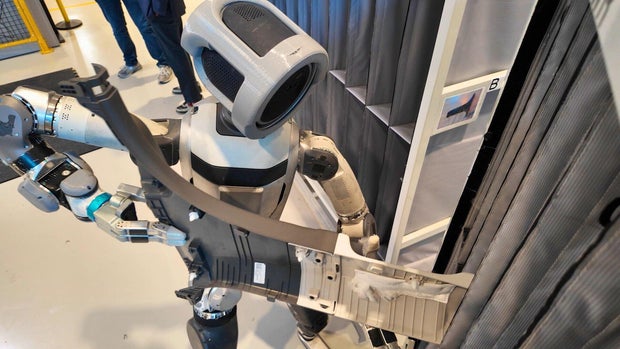
For manufacturers, integrators, and automation leaders, this moment signals something important: the future of automation is becoming more flexible, intelligent, and human-centric than ever before.
From Pre-Programmed Machines to Learning Robots
Traditional industrial robots excel at repetitive, highly structured tasks. They’re fast, accurate, and reliable — but only within carefully controlled environments. Humanoid robots like Atlas represent a different approach.
Instead of being programmed line by line, Atlas is being trained using artificial intelligence and machine learning. Engineers demonstrate tasks, capture motion data, and allow the robot to practice both physically and in digital simulations. Over time, Atlas learns how to perform tasks autonomously and adapt when conditions change.
This shift — from rigid programming to learning systems — is one of the most important developments in modern automation.
Why Humanoid Robots Matter for Manufacturing
Factories, warehouses, and industrial facilities are built around people. Aisles, shelving, tools, and workstations are designed for human height, reach, and movement. That creates a challenge for traditional automation, which often requires expensive redesigns to accommodate robots.
Humanoid robots change that equation.
Because they share a human-like form factor, they can:
-
Navigate existing factory layouts
-
Reach standard shelves and bins
-
Handle tools designed for human hands
-
Perform varied tasks without major infrastructure changes
This makes humanoid robots especially attractive for brownfield facilities, where flexibility and retrofitting costs are major concerns.
AI as the Brain Behind the Robot
What truly separates today’s humanoid robots from earlier attempts is the role of AI. Atlas doesn’t just execute motions — it builds an internal understanding of the physical world.
Through large-scale simulation training and real-world feedback, the robot learns:
-
How objects behave when lifted or dropped
-
How balance shifts during movement
-
How to recover from mistakes or unexpected obstacles
This ability to learn through trial, error, and refinement mirrors how humans develop skills — and it’s what makes robots like Atlas viable outside of controlled lab environments.
Automation and the Workforce: Replacement or Reinforcement?
Any discussion of advanced robotics raises concerns about job displacement. The 60 Minutes segment acknowledged this reality, but it also highlighted a more nuanced truth.
Most manufacturers today face:
-
Skilled labor shortages
-
High injury rates in physically demanding roles
-
Rising pressure to increase output without sacrificing quality
Humanoid robots are being positioned not as replacements for human workers, but as force multipliers — taking on repetitive, dangerous, or physically taxing tasks so people can focus on higher-value work.
As automation evolves, new roles emerge in:
-
Robot supervision
-
Maintenance and diagnostics
-
AI training and optimization
-
Systems integration
The nature of work changes — it doesn’t simply disappear.
What This Means for the Future of Automation
The takeaway from last night’s feature is clear: intelligent, adaptable automation is accelerating. Humanoid robots may not replace traditional industrial robots — but they will complement them, filling gaps where flexibility and human-like movement are required.
For companies focused on automation, robotics, and AI, this moment represents both an opportunity and a challenge:
-
How do you design systems that blend traditional automation with AI-driven robotics?
-
How do you prepare facilities and teams for more intelligent machines?
-
How do you stay competitive as automation becomes smarter and more adaptable?
At Automation Hub, we see this as the next phase of industrial evolution — one where software, AI, and robotics converge to create smarter, more resilient operations.
The future of work isn’t coming someday.
It’s already stepping onto the factory floor.
Ready to Take the Next Step?
Humanoid robotics and AI-driven automation aren’t future concepts — they’re here, and they’re reshaping how work gets done on the factory floor.
Automation Hub is already working with humanoid robotics and advanced automation technologies, helping manufacturers and more understand where these systems fit, how to deploy them, and how to do it without disrupting existing operations. Whether you’re just beginning to explore intelligent automation or ready to move beyond traditional robotics, our team can help you navigate the transition with clarity and confidence.
The next industrial revolution is underway.
Let Automation Hub help you step into it.